bridgetgrady.com
“December Swamp”,7”x 9”, Gouache on Paper, “The Art of Conservation 2010”,published work
Bridget Grady, a 2004 graduate of the WestConn MFA program, spent four and a half years as an assistant professor of Art at the School of Art, Design and Media at Nanyang Technological University in Singapore (
http://www.ntu.edu.sg/Pages/default.aspx). While she was there she taught Foundation Drawing and Painting, along with developing workshops to expand the art curriculum. She has recently been awarded the Nanyang Technological University Teaching Excellence Award.
Bridget said she loved her students. “They were the highlight of the experience. They were so motivated, hard-working, and had a great respect for education”. Bridget said she learned about the culture primarily from her students.” They were so generous. They took my husband and I, all around Singapore. Invited us to their homes and honored us with the privilege of attending some family events. I can’t say enough about them”.
Living in Singapore allowed her to see things she would never see here. “Experiencing in Southeast Asia for the last four and a half years has had a significant impact on my world view. I was fortunate enough to be able to travel to many different countries, New Zealand, Bali and Sumatra, Indonesia, Malaysia, Australia, Vietnam, and India. The first hand witnessing of the environmental, social, and economic challenges of the developing nations of Southeast Asia has just deepened my consideration of the role of the artist within these contemporary concerns”. My visual art always has been focused on nature and environment in one form or another. It is my belief that the teaching of the visual arts is an avenue where one can effectively promote sensitivity to ones environment and become an instrument for creative change. So the opportunity to live in Southeast Asia provided fertile ground to explore this more deeply.
Bridget said, “The education I’ve obtained from teaching in Singapore was like my third graduate school because it was a yet another process of thinking about and making art.”Specifically in re-defining what artists do as practiced based research. My previous studies at Norwich University were focused on critical theory, political activism, and writing, Westconn was more along the lines of developing concept from practice. My teaching at NTU was a fusion of those experiences with the addition of digital media and the moving image. The Art school was new and positioned in an engineering and science research University. Not exactly a comfortable fit in the beginning. I don’t think the engineers knew what to do with us initially. There were some growing pains for the artists and the school in relation to conforming to a research oriented mandate. “It’s not as if the concept of painting as research is new. In my opinion it is a form of research. It is just how it is contextualized”. “In order to be considered research active, artists have to ‘sell’ their practice as “legitimate” research”. A research university primarily recognizes the production of data, patents, peer reviewed publications and citations as its key performance indicators (KPI). Teaching has in the past not been heavily factored into the performance of an instructor. Work created that is not attached to a grant has also has difficulty in being recognized as research. This is especially true in the case of painters whose work may not necessarily involve developing a product for industry or the production of a peer- reviewed paper. Most of my work was self funded initially because my visual art and teaching practice didn’t involve this type of outcome at the time. For artists and painters in particular, it has been standard practice that exhibition is used as evidence of research production. As a teacher my main focus was the student’s personal growth and success, not necessarily to function as my research assistants. I was able to secure a grant for the series I was working on titled”Glut”. This body of work was an integration of my interests in the environment, consumption, agriculture, and history. By incorporating digital technology, a social science methodology, and research students I began to find a way to negotiate a bridge between the humanities and sciences.

"Conversation with Pieter and Paul”, Traditional and Digital artwork, 2010
The central piece in the “Glut” series is called the “Conversation with Pieter and Paul”. As the title suggests it is a visual discourse between two historical epochs in painting. This painting juxtaposes the compositional and narrative features of two master’s works. Gauguin’s “Where Do We Come From? Who Are We? Where Are We Going?” and 16th century painter Pieter Aertsen’s “The Butcher Stall”. The work poses questions surrounding desire, tradition, mass production and the effects of Western material culture on developing nations in Southeast Asia. . Through the studio integration of traditional, observational painting, inventive painting, digital painting, digital collage and collaged reproductions of my still life paintings, several more layers of meaning were developed. These layers revealed a sub-narrative on the history of still life painting, visual conversations between painters that crossed time, and painting technology. It was a continuation of dialogue with my previous landscape work, and desire to express questions and concerns about the condition of nature and our impact on it through the painted image. It just looked a lot different.
“Parable”, 96” x 96”, traditional and digital work ,2010
A corollary research project was started that originated from this series. It was titled “A Visual Feast” and some of the results can be found at ADM A Visual Feast (
http://admavisualfeast.wordpress.com/2010/11/26/so-ta-pia/).
“Century Egg”, 4” x 6”, Oil on panel, 2010
She knew at some level she wanted to make these students more aware of the connection between food, luxury food products in particular, such as meat and the impact of the growing deforestation issues that were connected to agricultural production. Bridget explained, "I lured them in with a painting project. The premise was to train them in an observational painting program that borrowed from old master’s technique and that particular platform of teaching. The project eventually took its own turn and became each students own personal research, which is the way I was frankly more comfortable with. Using my live-work space a safe environment for creative work and dialogue allowed for the traditional power structures between students and teacher to be softened. We shared traditional foods from both cultures and both parties gained insights into the everyday lives of the different cultures. The structure of the project required that the students gather personal histories from their elder family members. This is apparently not a typical practice in Singaporean culture. The paintings became invitations to dialogue with their families which allowed them to learn more about their own rapidly changing culture and in some cases their own personal family histories. This in turn was extended to a wider audience through the web platform. The project was peer-reviewed and published in the International Society of the Arts Journal 2010. The painting “Conversation with Pieter and Paul”, was included in the International Painting Annual 1 and is published by the Manifest Creative Research Center in Cincinnati. The book will be out in August."
Bridget was involved in other related areas of interest simultaneously. "I often have several projects going at the same time so it takes awhile before I have the work thought out enough to begin to show it”. Some of the work from her tree series and wetlands project was published in the “The Art of Conservation, An International Exhibit Of Nature in Art”, Artists for Conservation Foundation, in association with Heliconia Press, Inc., Beachburg, Ontario,2010. She was also a finalist in the Natural Resource Defense Council’s Environmental Art Prize . That work was exhibited at the Nabi Gallery, NYC.
“Peranakan Tree”,48” x 48”, Oil on Canvas,2010, Natural resource Defense Council Environmental Art prize Finalist.
She also has a work from Art vs Oil spill
http://www.facebook.com/group.php?gid=124568567574068 featured on Zazzle. Proceeds from that piece are donated to wildlife rehabilitation efforts from the B.P. Oil disaster 2010.
http://www.zazzle.com/louisiana_walrus_by_bridget_grady_tshirt-235699646834261823
“Louisiana Walrus”, Art VS. Oil Spill, Watercolor and digital 7” x9”, 2010
Currently she also has a Sketchbook project on traveling exhibition. You can follow this on Arthouse Coop main,
http://www.arthousecoop.com/, Arthouse coop my link,
http://www.arthousecoop.com/users/12bridget/artwork . The current tour dates are,June 16-18, 2011, Madrone Studios, San Francisco, CA,July 14-17, 2011 ,Hyde Park Art Center, Chicago, IL ,July 29-31, 2011 Full Sail University, Winter Park, FL.
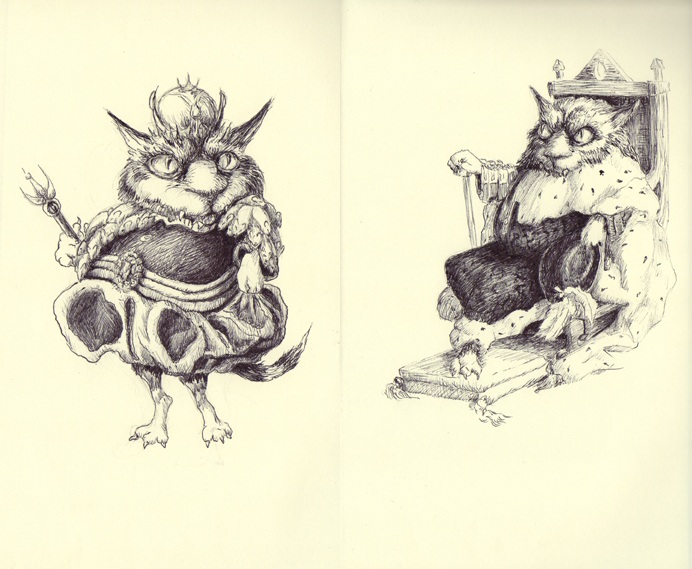
Selection from “ Its Reigning Cats and Dogs”. Pen and ink, 2010

She says her teaching definitely affected some of the direction of her research.”Because I was teaching people with a very wide range of experience or ability it caused me to re examine the way drawing is normally taught in the college environment. Some of my students were film, photography, or interactive design majors with often with no drawing experience. The animation, viscom, or product design majors needed a different diet of drawing practice. My own personal experience with these digitally oriented practices, outside of illustration or comics, was pretty much non- existent before then”. In that sense I definitely learned a lot from my students and felt there was an “in it together” attitude in the instructional arena. It gave me an opportunity to re investigate a way of drawing that I had departed from for a good 20 years. When I got out of college in the 80’s, tightly realistic work was definitely not encouraged. Conceptualism was favoured over observational skill. There has often been an attitude that having skill somehow precludes thinking.

Nor was there much of an emphasis on the hand drawn perspective courses that could be found in industrial design. That attitude is finally changing. By gathering feedback from my students I was able to create courses that could touch on the specific needs of the technological arts along with aesthetic considerations. The root of it is still training in perceptual skill combined with analytical thinking to produce opened ended results.
Observational drawings graphite 2009-2010
Now that Bridget is back in Connecticut, she has re-opened her studio in Watertown, Ct. Her core interest is to teach an appreciation of the environment and develop creativity through training in perceptual practice. She hopes that the space will develop as a community center for an integration of Nature and Culture. The platform for this integration will be exhibition, both physical and virtual, lectures, workshops, or formal instruction In the past she has curated invitational exhibitions and open studio events as the Porter Street Artist Collective. Her husband Jay Foster will be teaching Music and audio/visual technology workshops in the adjoining space. This has expanded the exhibition space two fold. She has students and has a few more openings, and although she has a primarily adult classes listed now ,she will be accepting all ages in the near future. Her Singaporean students’ work is also included on her blog
http://www.bluehorsearts.blogspot.com.
Bridget is continuing to work on audio/visual collaborations with her husband, multi media artist, Jay Foster. We have been working on some short animations involving Bestiaries, genetic modification, beavers, and some good old fashioned silliness.:) That will be coming soon.
Bt Bat Cat Avenger, graphite, pen and ink, digital collage, animation work in progress.
Teaching website
www.bluehorsearts.com
Artwork/visual research
www.bridgetgrady.com
Sound and audio
www.jfostermusic.com